

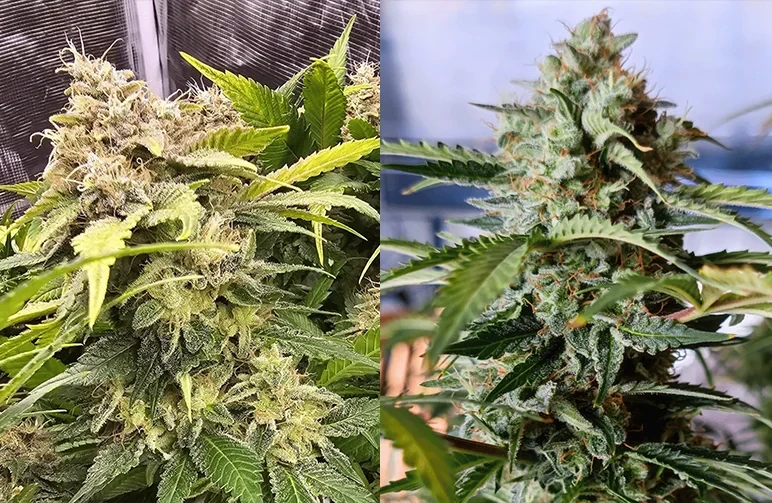
You are staring at a seed catalog with two tabs open. One says autoflower seeds. The other says feminized seeds. Both promise sticky, top-shelf buds. But which one should you actually buy?
It is the very first choice every new grower has to make, and it can be incredibly stressful.
If you buy the wrong type of seed for your specific grow tent or your timeline, you are setting yourself up for a bad time.
You might end up with a plant that grows way too tall for your closet, or a plant that flowers before you are ready.
But do not panic. In this guide, we are going to break down the autoflower versus feminized debate in plain English. No bro-science, just the facts.
By the end of this page, you will know exactly which seed fits your grow room so you can start your run with total confidence.
Key Takeaways
- The big mix-up: "Feminized" just means the plant is female. Almost all autoflowers are actually feminized too. The real debate is Autoflower versus Photoperiod.
- Autos are for speed: If you want a fast harvest and a simple, set-and-forget light schedule, autoflowers are your best bet.
- Photoperiods are for size: If you want massive yields and total control over how big the plant gets, go with photoperiods.
- Mistake recovery: Photoperiod plants give you time to heal if you mess up. Autoflowers are on a strict timer and do not wait around.
The Biggest Beginner Trap: What Do These Words Actually Mean?
Before we go any further, we need to clear up a massive trap that catches almost every new grower. People think "feminized" and "autoflower" are opposites. They are not.
"Feminized" just means the seed is guaranteed to grow into a female plant. Female plants make the sticky buds we want to harvest. Male plants just make pollen. You always want female plants.
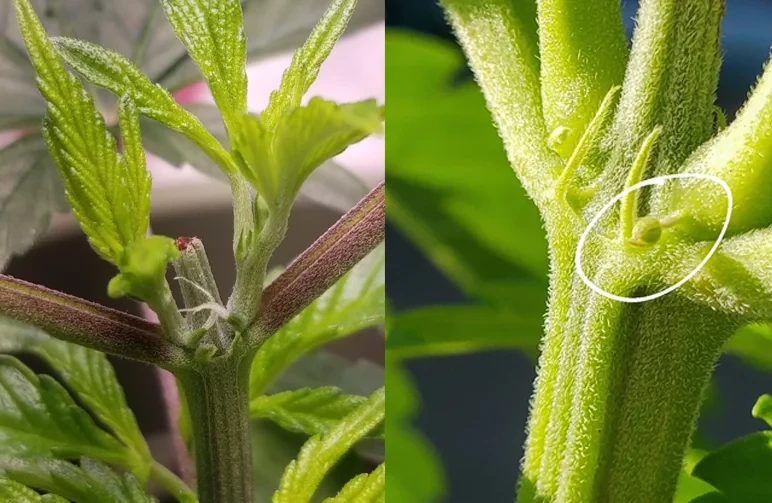
"Autoflower" describes the lifecycle of the plant. It tells you exactly how the plant decides to start making buds.
Here is the big secret. Almost all autoflower seeds are also feminized. When growers argue about "Autoflowering vs. Feminized," they are actually comparing Autoflowering genetics to Photoperiod genetics.
Photoperiods are the classic weed plants that need a strict light schedule to make buds. Autoflowers are the modern hybrids that make buds based on their age.
At a Glance: The Quick Comparison
Here is a quick cheat sheet to show you exactly how these two types of seeds stack up against each other.
| Feature | Autoflowering Seeds | Feminized Photoperiod Seeds |
|---|---|---|
| Best For | Beginners, small spaces, fast harvests | Maximum yields, cloning, expert training |
| Growth Trigger | Age (Automatic) | Light Cycle (Photoperiodism) |
| Seed to Harvest | 8 to 11 Weeks | 12 to 20+ Weeks |
| Height | Compact (2 to 4 feet) | Customizable (can reach 6+ feet) |
| Mistake Recovery | Low (Fixed clock) | High (Can stay in veg to heal) |
| Cloning | No | Yes (Infinite copies) |
What Are Feminized Photoperiod Seeds? (The Control Option)
Photoperiod plants are the classic way to grow weed. In nature, these plants rely on the sun and the changing seasons to know when to make buds.
When the days get shorter at the end of summer, the plant knows winter is coming. It panics and starts flowering to reproduce.
When you grow indoors, you are the sun. You control the seasons with your light timer.
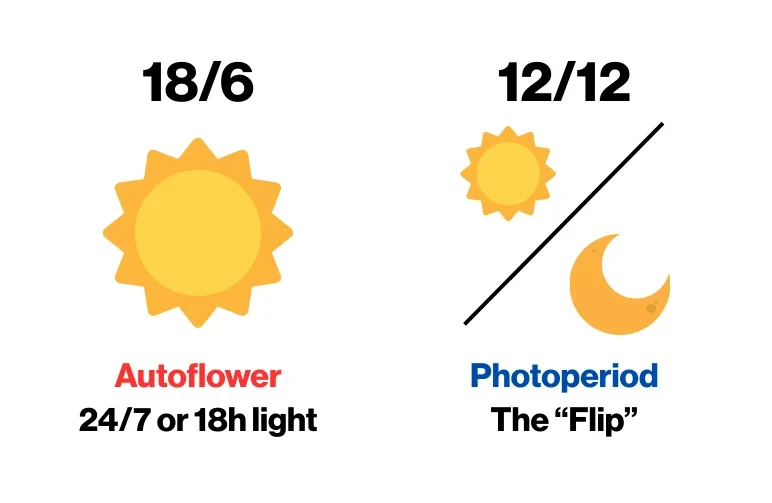
As long as you give a photoperiod plant 18 hours of light every day, it will stay in the vegetative stage. It will just keep growing bigger and growing more leaves. It will never make buds.
To force the plant to flower, you have to "flip" your light timer to 12 hours on and 12 hours of total darkness.
The Pros
- Infinite Recovery Time: This is a massive safety net for beginners. If you burn your plant with nutrients or accidentally snap a branch, you can just keep the lights on for 18 hours a day. The plant stays in the vegetative stage until it is completely healed.
- Massive Yields: Because you control when the plant flowers, you control how big it gets. You can keep a plant in the vegetative stage for months and grow a literal tree.
- Cloning: If you grow a plant that smells amazing and hits hard, you can cut a small branch off and plant it. This is called taking a clone. You can grow that exact same plant forever without buying more seeds.
The Cons
- The Fixed Clock: This is the biggest warning for beginners. Autoflowers have a strict, pre-programmed lifespan. If you burn the plant with nutrients or overwater it in week three, it does not have time to pause and heal.
It will just keep moving into the flowering stage, even if it is stunted. Because timing is so critical with these genetics, we highly recommend reading our complete guide on how to grow autoflowers so you can nail the first 20 days perfectly. - Smaller Yields Per Plant: Because they grow so fast, they do not have time to get massive. A single autoflower will yield less weed than a massive photoperiod tree.
The Head-to-Head Comparison
Let's put these two types of seeds in the ring. Here is exactly how they match up on the things that actually matter to your grow.
Speed to Harvest
Autoflowers win this round easily. If you want weed fast, autos are the only way to go. Most autoflowers finish their entire life cycle in 8 to 11 weeks.
Photoperiod plants take their time. You have to wait through a long vegetative stage, and then wait another 8 to 11 weeks just for the flowering stage to finish.
You are usually looking at four to six months before you can grab your scissors.
Yield and Plant Size
Photoperiods are the heavyweight champions of yield. Because you control the vegetative stage, you can grow a plant as big as your tent allows.
A single photoperiod plant grown in a 5-gallon pot can easily out-yield three autoflowers.
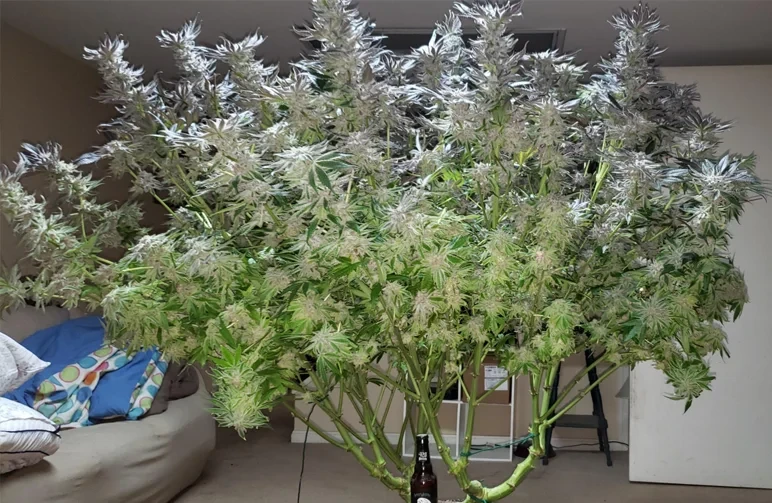
However, autoflowers win on yearly efficiency. Because they grow so fast, you can fit three full harvests of autoflowers into a single year. If you look at the total weight you grew over 12 months, the numbers often balance out.
Plant Training
Photoperiod plants love to be trained. You can use High Stress Training (HST) like topping. This means actually cutting the main tip off the plant to force it to grow two main colas.
The plant will take a few days to heal and then explode with new growth.
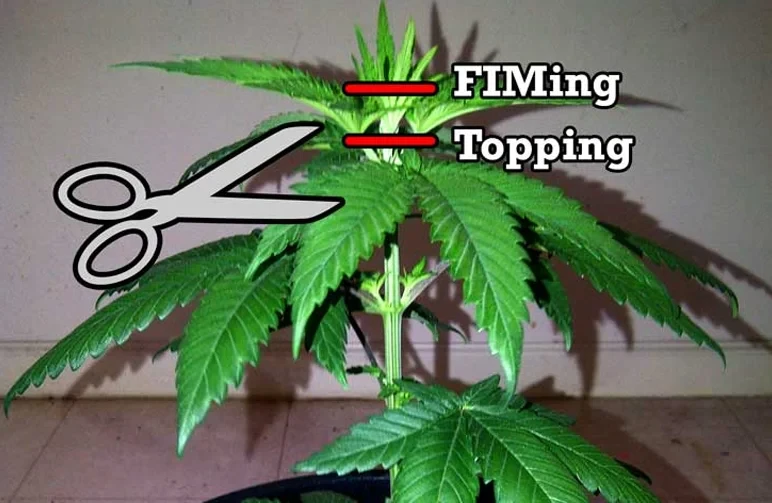
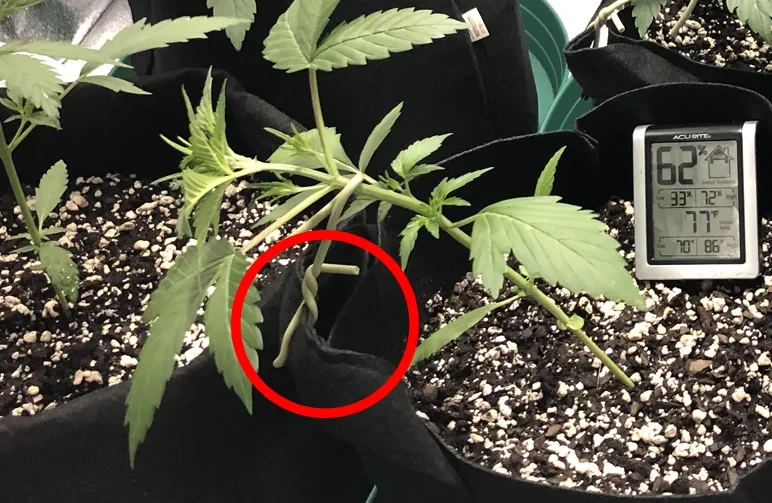
Autoflowers hate high stress. If you cut the top off an autoflower, you will stunt it permanently. For autos, you must stick to Low Stress Training (LST).
This means gently bending and tying the branches down to open up the canopy without actually cutting or hurting the plant.
Which Seed Should You Choose?
There is no single "best" seed in the world. There is only the right seed for your specific setup, your timeline, and your personal goals. Let's make this decision easy.
Choose Autoflowers If...
- You want your first harvest as fast as possible.
- You are growing in a small closet or a stealth grow box where space is tight.
- You want to grow outdoors in a region with short summers and cold falls.
- You want to avoid the anxiety of flipping light schedules and worrying about light leaks in your tent.
Choose Feminized Photoperiods If...
- You want the absolute biggest yield possible from a single plant.
- You want to learn the art of advanced plant training and shaping a massive canopy.
- You want the safety net of being able to pause the plant and fix your mistakes during the vegetative stage.
- You want to save money by taking clones of your favorite plants so you never have to buy seeds again.
Frequently Asked Questions
I get a lot of the same questions from growers who are stuck trying to pick their first pack of seeds. Let's clear up a few common worries.
Are autoflowers less potent than feminized seeds?
Short answer: No. In the early 2000s, autoflowers were considered weak because the original Ruderalis genetics had very low THC. But modern breeding has completely changed the game.
Today, autoflowers are absolute powerhouses. They routinely test at 25 percent THC or higher. Potency today is all about good genetics and a good environment, not the type of seed.
Can I grow both in the same tent?
You can, but it is a bad idea. Autoflowers want 18 hours of light every single day to grow fat buds. Photoperiods need you to flip the lights to 12 hours on and 12 hours off to start flowering.
If you flip your tent to 12/12 for the photoperiod plant, you are robbing your autoflower of 6 hours of light every day. Your autoflower yield will suffer massively. Pick one type of seed per tent.
Do feminized seeds ever turn male?
Yes, they can. Any female weed plant can produce male pollen sacks if it gets severely stressed. We call this turning into a hermaphrodite, or a "hermie."
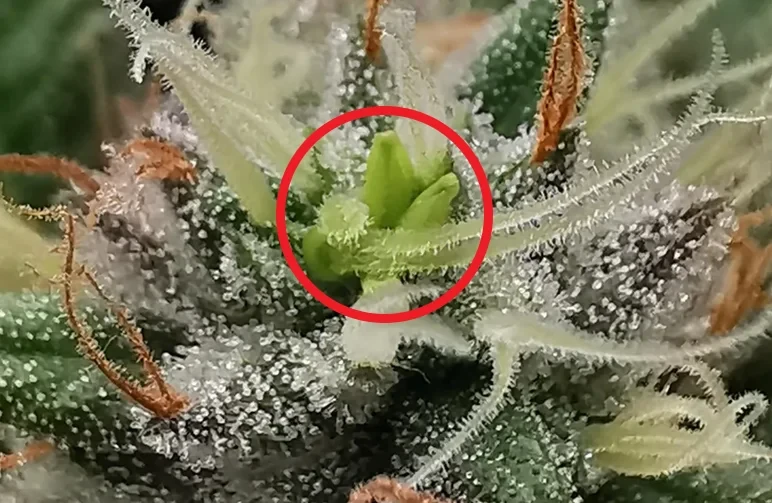
For photoperiod plants, the biggest trigger for this is light leaks during their 12-hour dark period. Keep your tent 100 percent dark at night and maintain a steady temperature to keep your females happy.
The Wrap Up
There is no such thing as the "best" seed in the world. There is only the right seed for your current setup.
Autoflowers give you a fast track to success.
They are tough, quick, and require much less technical management. Feminized photoperiods give you total control. They let you build massive canopies, take clones, and harvest huge yields.
Figure out how much space you have and how much patience you have. Pick your winner, pop those seeds in the dirt, and let's get growing. You have got this.