If you grow cannabis long enough, indoors or out, you'll eventually tango with powdery mildew. It's the chalky, ghost-white fungus that creeps in when humidity's cozy, airflow's meh, and leaves are stacked like poker chips.
The good news? We can beat it. The better news? We can stop it from coming back.
In this guide, we'll show you exactly how to spot powdery mildew early, treat it without nuking your plants, and harden your garden so it's not invited back.
We'll speak from our grow tents and test beds, from sticky-fingered experience and lab-backed best practices, so you can keep your canopy clean and your jars full.
Key Takeaways
Appearance: Powdery mildew (PM) looks like white, powdery spots on leaves and buds. It thrives in humid, stagnant air with temperatures between 60–80°F.
Early Detection: Regular plant inspection, using tools like a hand lens, is crucial for catching PM before it spreads.
Immediate Actions:Isolate affected plants, prune infected areas, and immediately improve airflow and lower humidity to halt the spread.
Treatment Options: Natural remedies like baking soda sprays, milk solutions, and neem oil can treat early-stage PM. Organic fungicides are effective for more severe cases.
Prevention is Key: Maintain good air circulation, proper plant spacing, water at the root zone, and select mildew-resistant cannabis varieties to prevent future outbreaks.
While this guide focuses on Powdery Mildew, identifying fungal issues is just one part of maintaining a healthy garden.
For a full breakdown of pests, nutrient deficiencies, and diseases, visit our comprehensive cannabis troubleshooting guide.
What Is Powdery Mildew? A Gardener's #1 Fungal Foe
Understanding the Fungal Disease
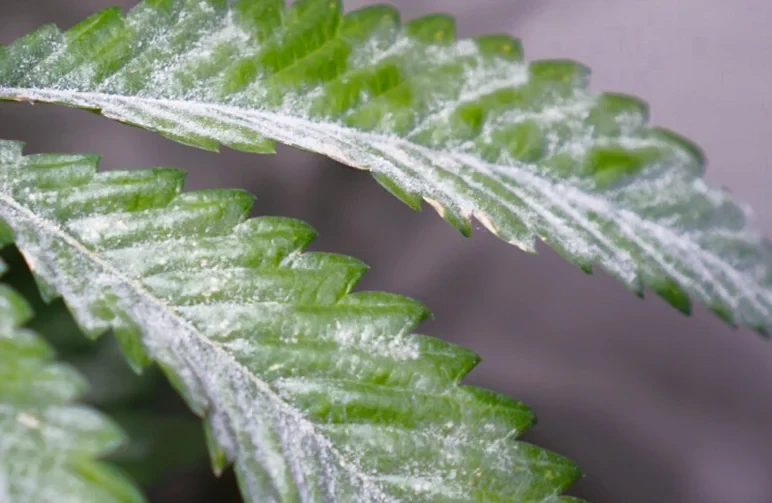
Powdery mildew is a family of fungi that shows up as white, talc-like dust on leaves, stems, and, worst-case, buds. It thrives in moderate temps (roughly 60–80°F), high relative humidity, and stagnant air.
Unlike some leaf diseases, it doesn't require wet foliage to get rolling; a humid microclimate is plenty.
On cannabis, it robs vigor, slows growth, dulls terpenes, and can brutalize yields if left unchecked. Most plants won't die from powdery mildew, but they'll sulk, yellow, and drop leaves.
On buds, the risk isn't just cosmetic—contaminated flowers are a health hazard.
How Powdery Mildew Spreads from Plant to Plant
Spores ride air currents. They hop from plant to plant in tight, shady gardens and crowded tents, especially where leaves touch and ventilation is weak. One shaken plant can puff spores across a room like a dandelion clock.
Your tools, clothing, and even pets can assist that journey, too. Once established, spores form chains you can spot with a hand lens. Translation: prevention and early action matter, a lot.
How to Spot Powdery Mildew: Early Identification is Key
The Telltale Signs: What to Look For
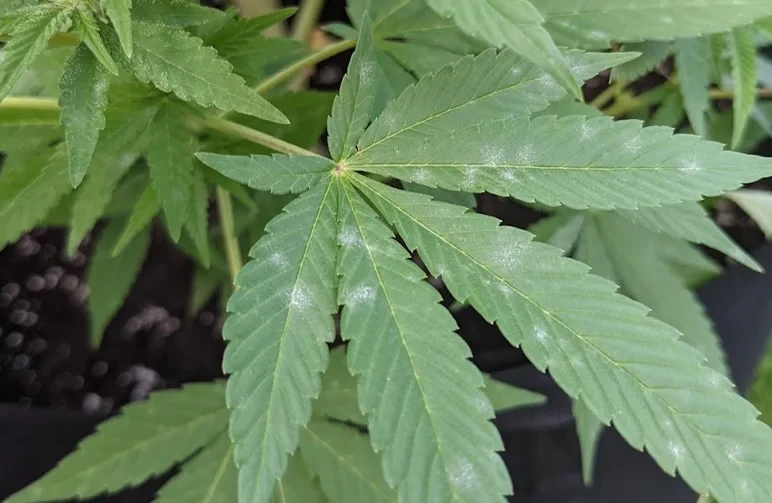
Early Warning: These faint, flour-like spots on the upper surface of the fan leaf are the classic first signs of a Powdery Mildew infection. If you catch it at this stage, it is much easier to manage. (Image credit: u/DanWallace via Reddit)
Start with the uppers. You'll often see faint white specks on the top sides of leaves, like someone dusted them with flour. You might also notice small chlorotic (yellowish) spots, a loss of sheen, slight leaf curl, or a tired droop.
Left alone, those dots merge into bigger patches until entire leaves look frosted. In a tent, we usually find it first on fan leaves in the mid to upper canopy where air stalls near lights.
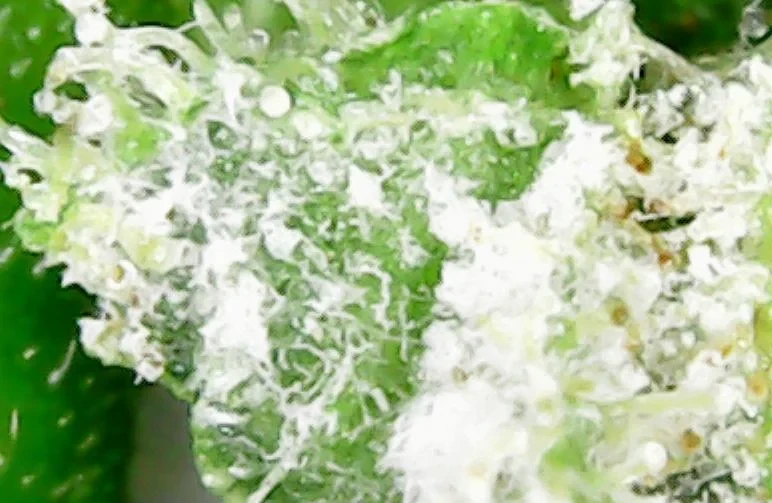
Pro Tip: Use a hand lens or a jeweler's loupe. With magnification, you'll see the powdery, branching chains of spores that confirm it's PM. If you can write your name on the leaf with a pinky swipe… you've got it.
Under the Loupe: A magnified view reveals the difference between bulbous, resinous trichomes and the matted, web-like structure of powdery mildew. If the "frost" looks fuzzy or stringy rather than like individual crystals, it's PM. (Image credit: u/RedMike9 via Reddit)
Visual Guide: What Powdery Mildew Looks Like on Leaves, Stems, and Buds
Leaves: A white, dusty film appears on upper surfaces first; the underside can follow. This leads to yellowing halos, eventual distortion, and premature leaf drop.
Stems/Petioles: Look for pale, chalky streaks that look like ash rubs.
Buds: A fine, ghostly dust gets caught in sugar leaves and crevices.
Common Plants Most Susceptible to Powdery Mildew
Beyond cannabis, PM loves cucumbers, squash, pumpkins, peas, roses, and zinnias. Outdoors, if your neighbor's squash patch is dusted, count on spores floating your way.
Indoors, clones from questionable sources are frequent Trojan horses.
Powdery Mildew vs. Downy Mildew: Knowing the Difference
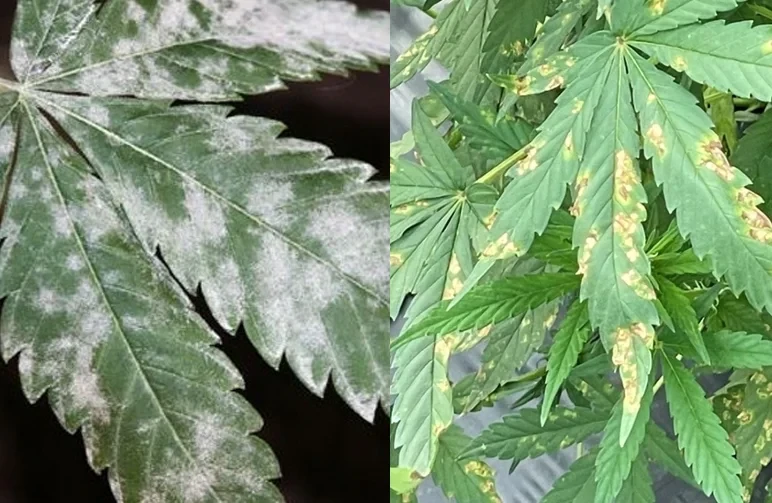
Know Your Foe: On the left, Powdery Mildew appears as a white, dusty coating on the leaf surface (Image: u/TheInvestmentGod). On the right, Downy Mildew shows up as yellow or brown chlorotic blotches within the leaf tissue (Image: C. Smart / Cornell University).
Don't mix these up when choosing treatments—they are different diseases.
Powdery Mildew: White, talc-like powder on the TOP of leaves and stems. Thrives in humid air even when foliage isn't wet.
Downy Mildew: Grayish or purplish fuzz mostly on the UNDERSIDES of leaves, often with yellow blotches on the top surface. Requires high moisture on the leaf itself.
What Causes Powdery Mildew to Appear in Your Garden?
The Perfect Conditions for Fungal Growth: Humidity, Temperature, and Airflow
PM is an environmental opportunist. It loves 60–80°F with Relative Humidity (RH) that hangs high, especially when nights cause humidity to spike.
Stagnant air from dense foliage creates microclimates where RH hovers in the danger zone.
Indoors, aim for 50–60% RH in veg and 45–55% in flower (strain-dependent), with strong air exchange and gentle, continuous canopy movement. Outdoors, morning sun plus afternoon breezes are your best friends.
Common Garden Practices That Encourage Mildew
Overcrowding plants and skipping pruning. Leaves kissing leaves is PM heaven.
Overhead watering late in the day, which prolongs leaf wetness.
Weak ventilation or dead air corners in tents.
Low light or shady placements outdoors.
Reusing contaminated stakes, ties, or fabric pots without proper sanitation.
Bringing in clones or cuts without a strict quarantine period. We quarantine every new arrival, no exceptions.
Tools & Supplies for Fighting Powdery Mildew
Before you go to battle, get your gear ready. Having these on hand allows you to act fast at the first sign of trouble.
Hand Lens or Jeweler's Loupe: For positive identification.
Pruning Snips: For carefully removing infected leaves.
Isopropyl Alcohol (70%) or Bleach Solution: For sanitizing tools between every single cut.
Spray Bottles: Have at least two, clearly labeled for different treatments.
Protective Gloves: To keep your hands clean and prevent spreading spores.
Oscillating Fans: To immediately improve air circulation around the canopy.
Your Chosen Treatment: Whether it's baking soda, neem oil, or a commercial fungicide.
How to Get Rid of Powdery Mildew: A Complete Treatment Guide
Before You Treat: Essential First Steps
Isolate:Isolate the affected plant immediately. If you can't move it, create as much distance as possible from other plants.
Prune: Carefully remove infected leaves and small stems. Place them directly into a bag and discard them—do not compost them.
Sanitize: Clean your pruning tools with alcohol between each cut. Change your shirt or apron if you think you've been in a "spore shower."
Dial In Environment:Immediately increase airflow. Lower your RH by 5-10% and, if possible, bump the temperature up 1-2°F to help drop the relative humidity further.
Natural & DIY Home Remedies That Actually Work
These are best for early infections and prevention. Always test-spray a single leaf and wait 24 hours before treating the whole plant. Treat in the evening or when lights are low, and avoid soaking mature buds.
Treatment
Type
Best For
Caution
Baking Soda Spray
DIY / Alkaline
Early stages, prevention
Can stress leaves if overused.
Milk Solution
DIY / Antifungal
Prevention, light infections
Requires bright light/UV to be effective.
Neem Oil
Organic / Fungal Disruptor
Prevention, early stages
Do not use on mature buds or within 2 weeks of sulfur.
The Classic Baking Soda Spray Recipe
Mix 1 tablespoon of baking soda + 1 teaspoon of mild liquid soap (like Dr. Bronner's) in 1 gallon of water. Spray to wet all leaf surfaces. The alkaline film disrupts fungal growth.
Using a Milk Solution as an Antifungal
Dilute milk 1:9 with water (a 10% milk solution). Mist foliage every 7–10 days. The proteins in milk, when exposed to bright light, have an antiseptic effect that inhibits fungi.
Harnessing the Power of Neem Oil
Use a quality cold-pressed neem oil at the label's rate (typically 0.5–1% solution) with a bit of mild soap as an emulsifier. Apply to leaves, but never spray on developed buds as it will ruin their taste and quality.
Effective Organic & Commercial Fungicides
When PM digs in, step up your game. It's wise to rotate between different active ingredients to prevent the fungus from developing resistance.
Potassium Bicarbonate: A heavy hitter. It rapidly kills spores on contact by altering pH. Use according to the label.
Sulfur-Based Fungicides: Old-school but effective. Use wettable sulfur preventatively or at the very first sign. Never use when temps exceed 85-90°F and not within 2-3 weeks of an oil-based spray (like neem) to avoid burning your plants.
Biological Fungicides: Products containing Bacillus subtilis (e.g., Serenade) use beneficial bacteria to outcompete and suppress PM, making them a safe and effective tool in your rotation.
CRITICAL HEALTH WARNING
Inhaling mold spores from contaminated cannabis can pose serious health risks, particularly for individuals with allergies or compromised immune systems.
Never smoke, vape, or ingest buds that show any signs of powdery mildew.
Knowing when to harvest cannabis safely means being able to distinguish between milky white trichomes and the fuzzy white threads of a fungal infection. When in doubt, throw it out. Your health is not worth the risk.
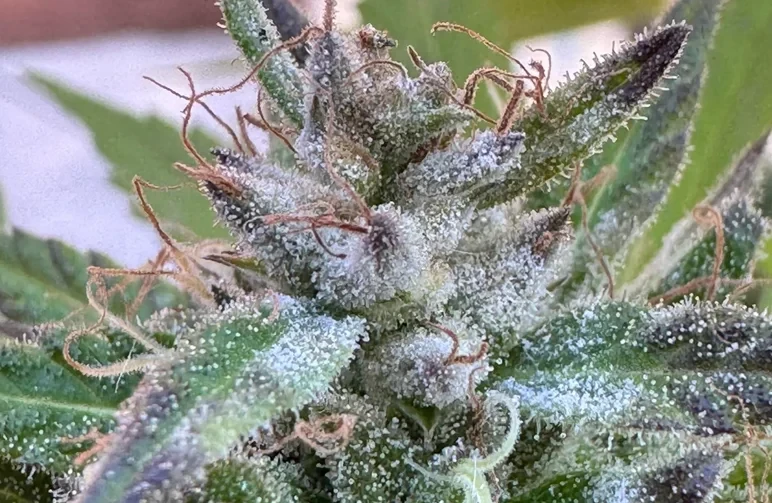
The Danger Zone: This bud shows Powdery Mildew (PM) masquerading as resin. Notice the patchy, "chalky" white areas that look flatter and duller than the surrounding sparkling trichomes. Buds in this condition are unsafe to consume. (Image credit: u/Pcollins10 via Reddit)
Step-by-Step Application: How to Safely Treat Your Plants
Prep: Treat at dusk or right before lights-out to prevent leaf burn. Keep fans on low to help dry the leaves.
Test: Spray one leaf and wait 24 hours. If there's no damage, proceed.
Coat: Apply your chosen spray from below and above to fully cover all surfaces until just before runoff.
Repeat: Reapply your treatment every 5-7 days (or per the product label) for 2-3 rounds to break the fungal life cycle.
Clean: After treatment, thoroughly wipe down your grow space—walls, fans, filters, and stakes—with a 10% bleach solution or 70% alcohol.
The Best Defense: How to Prevent Powdery Mildew from Returning
Promote Superior Air Circulation Through Pruning and Spacing
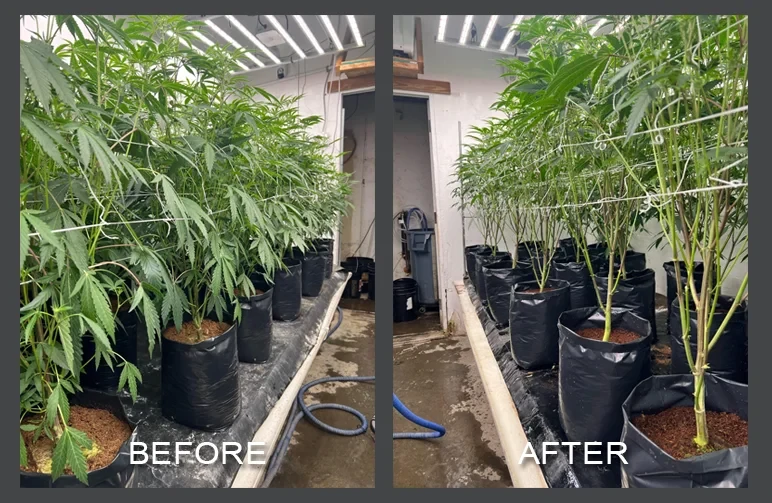
CapThe Power of Lollipoping: A clear "Before and After" showing how removing the lower growth—a technique called lollipoping—opens up the canopy. This prevents the stagnant "dead air" zones where powdery mildew loves to start. (Image credit: u/h1gh3r420 via Reddit) tion
Train your canopy for airflow. We lollipop lower branches and defoliate the densest fan leaves to ensure air can slide through the entire plant. You should see a gentle leaf flutter everywhere.
In tents, use multiple clip-on fans to erase dead air zones.
Master Smart Watering Techniques to Keep Leaves Dry
Water at the root zone, not overhead. Water in the morning (outdoors) or at lights-on (indoors) so any incidental splash dries quickly. High humidity during the dark cycle is a major trigger, so ensure your exhaust fans are properly timed.
The Critical Role of Sunlight and Proper Plant Placement
Outdoors, prioritize full morning sun to dry dew off the leaves. Indoors, ensure an even light footprint and avoid shadowy corners where air stales and humidity gathers.
Choosing Mildew-Resistant Plant Varieties from the Start
Genetics matter. Some cultivars are naturally more open and airy, while others have tight internodes that trap humidity.
When shopping for seeds, look for notes like "mold resistant" or "great for humid climates." Start clean, finish cleaner.
Frequently Asked Questions (FAQ) About Powdery Mildew
Is powdery mildew harmful to humans or pets?
It isn't typically toxic on contact, but you should never inhale the spores or smoke contaminated buds. Handle infected plants with gloves, especially if you have allergies, and always wash up after pruning.
Can you just wipe off powdery mildew from leaves?
You can wipe or rinse early spots, but this is only a temporary cosmetic fix. The fungal roots (haustoria) are still in the leaf, and the spores are still present.
You must follow up with a proper treatment and environmental correction to stop it from returning.
Will powdery mildew kill my plants?
Rarely. It's more of a chronic stressor that reduces photosynthesis, causes yellowing, and severely degrades the quality and yield of your harvest. An unchecked infection can weaken a plant to the point of failure.
When is the best time of day to apply treatments?
Evenings, at lights-off, or on an overcast day. Lower light intensity reduces the risk of leaf burn from sprays and slows evaporation, allowing the treatment to work longer.
The wrap-up: watch the plant, not the calendar. Scout often, fix the environment, act early, and if you're starting fresh, choose stout genetics from a trusted seed bank.
When you're ready, we're here with hand-picked, lab-tested seeds and straight-up grow support at Weedseedsexpress.