

If there's one fork-in-the-road decision every grower faces, it's male vs. female cannabis plants. Get it right early and you're on track for chunky, resin-stacked colas.
Miss it, and you risk a room full of seeded buds that smoke like regret.
We've sexed thousands of plants in our Amsterdam grow labs and test tents, and we'll walk you through exactly what to look for, when to look for it, and what to do next—calm, confident, scissors ready.
Key Takeaways
- Understanding male vs. female cannabis plants early prevents pollination, preserves potency, and saves space, nutrients, and time.
- Identify sex at the nodes between weeks 4–6: females show a pointed calyx with white pistils, while males form round pollen sacs with no hairs. A 12/12 light flip confirms sex within 7–14 days.
- If unsure, use a loupe, don’t mistake green stipules for pistils, and recheck in 24–72 hours before acting.
- Once you spot a male, isolate immediately, mist it to trap pollen, switch off nearby fans, remove and bag it, then clean tools and surfaces.
- Watch for hermaphrodites ("hermies") from stress (light leaks, heat, pH swings): tweeze early “nanners,” but cull repeat offenders and maintain a stable environment.
- For seedless harvests, choose feminised seeds from reliable sources. Only use regular seeds if you plan to breed.
Tools for the Job
Before you start hunting for pre-flowers, grab these simple tools. Being prepared means being precise, and precision protects your harvest.
- A Jeweler's Loupe or Magnifying Glass: This is the most important tool. A 30x-60x loupe makes tiny pre-flowers easy to see and eliminates guesswork.
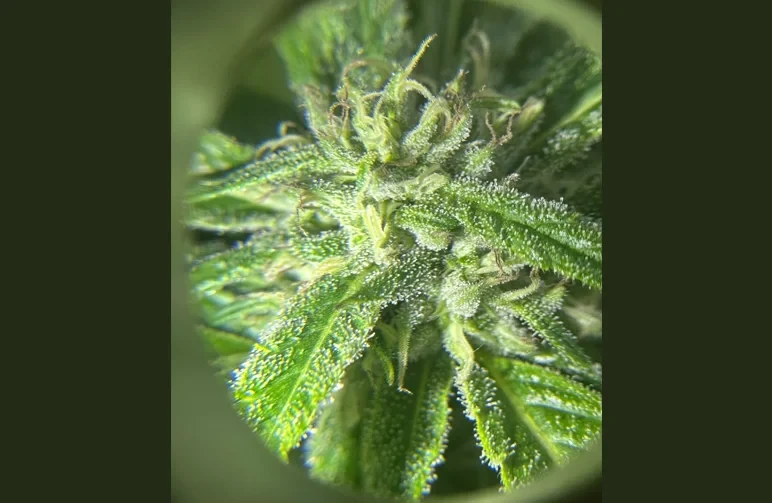
Precision Inspection: Using a jeweler’s loupe (as seen here) is the only way to eliminate guesswork. This 60x magnification allows you to see the fine details of the plant’s development—like these resinous trichomes and pistils—long before they are obvious to the naked eye.
Image credit: u/DangerousMood3159 via Reddit. - A Small Flashlight or Headlamp: Good lighting is non-negotiable for spotting subtle details in a dense canopy.
- Gloves and Tweezers: Essential for carefully removing any "nanners" on a hermaphrodite plant without contaminating other buds.
Why Sexing Your Cannabis Plants is Crucial for a Successful Harvest
Here's the blunt truth: male plants don't grow smokable buds. They grow pollen. And once that pollen hits your girls, the whole party changes.
Pollinated females divert energy to seed production instead of stacking weight and cannabinoids, so potency drops, buds shrink, and you end up picking seeds out of everything. Not fun, not flavourful.
- Early sexing keeps your canopy focused on unfertilized, resinous flowers—the good stuff.
- It prevents a single male from nuking an entire crop's quality. One open pollen sac can dust a room.
- It saves nutrients, space, and time for plants that will actually pay you back.
Most growers cull males the moment they're sure, especially indoors where a stray puff of air can move pollen everywhere.
Learning how to grow weed indoors successfully means mastering environmental control to prevent such accidents.
We've seen immaculate rooms go from "oh boy!" to "oh no..." in a week because someone hesitated. When in doubt, isolate and confirm fast.
Key Differences Between Male and Female Cannabis Plants at a Glance
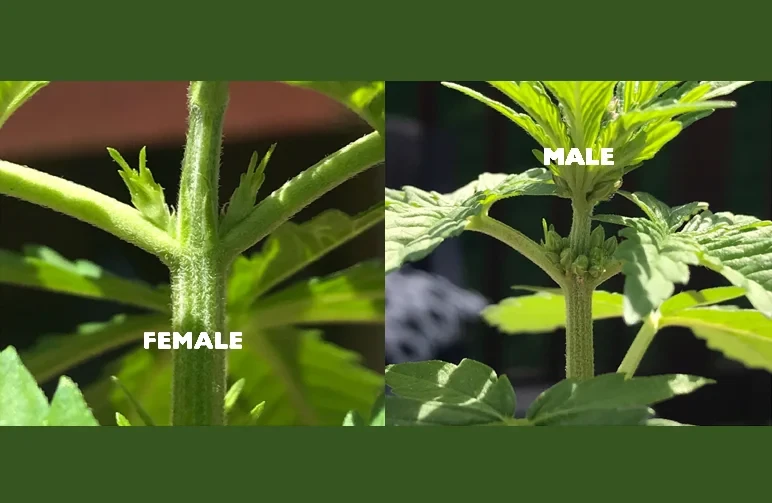
Image credit: u/novapants via Reddit.
Here's the quick visual cheat sheet we teach new growers.
| Feature | Male Plants | Female Plants |
|---|---|---|
| Bud Production | No usable buds | Resinous, THC/CBD-rich buds |
| Height & Structure | Often taller, lankier | Shorter, bushier, more branching |
| Leaves | Sparser | More abundant |
| Stalk | Thicker, sturdier | Generally slimmer |
| Key Feature at Nodes | Pollen sacs (round balls) | Pistils (white/orange hair-like) |
| Primary Purpose | Breeding, fiber, genetics | Consumption, extraction |
Males stretch earlier and build scaffolding. Females fill that scaffolding with calyxes, pistils, and later, sticky trichomes. Once you've seen both in the same run, the differences become obvious.
When Do Cannabis Plants Show Their Sex?
Most photoperiod plants flash "pre-flowers" around week 4–6 from germination. By week 6, you can usually call it with confidence. Autoflowers can show a touch earlier on the same timeline since their internal clock runs fast.
- Veg Phase: Look for tiny pre-flowers at the upper nodes where branches meet the main stem.
- Early Flower: Sex becomes definitive. You'll clearly see pistils for females or clusters of balls for males.
Expert Tip: Under an 18/6 or 20/4 light cycle, many photoperiods still show pre-flowers as they mature. If you flip your lights to 12/12 to initiate flowering, you will have a definitive answer on sex within 7–14 days.
How to Identify Female Weed Plants: A Step-by-Step Guide
We keep a jeweler's loupe on a lanyard for this. You don't need one, but it helps eliminate all doubt. Here's our process:
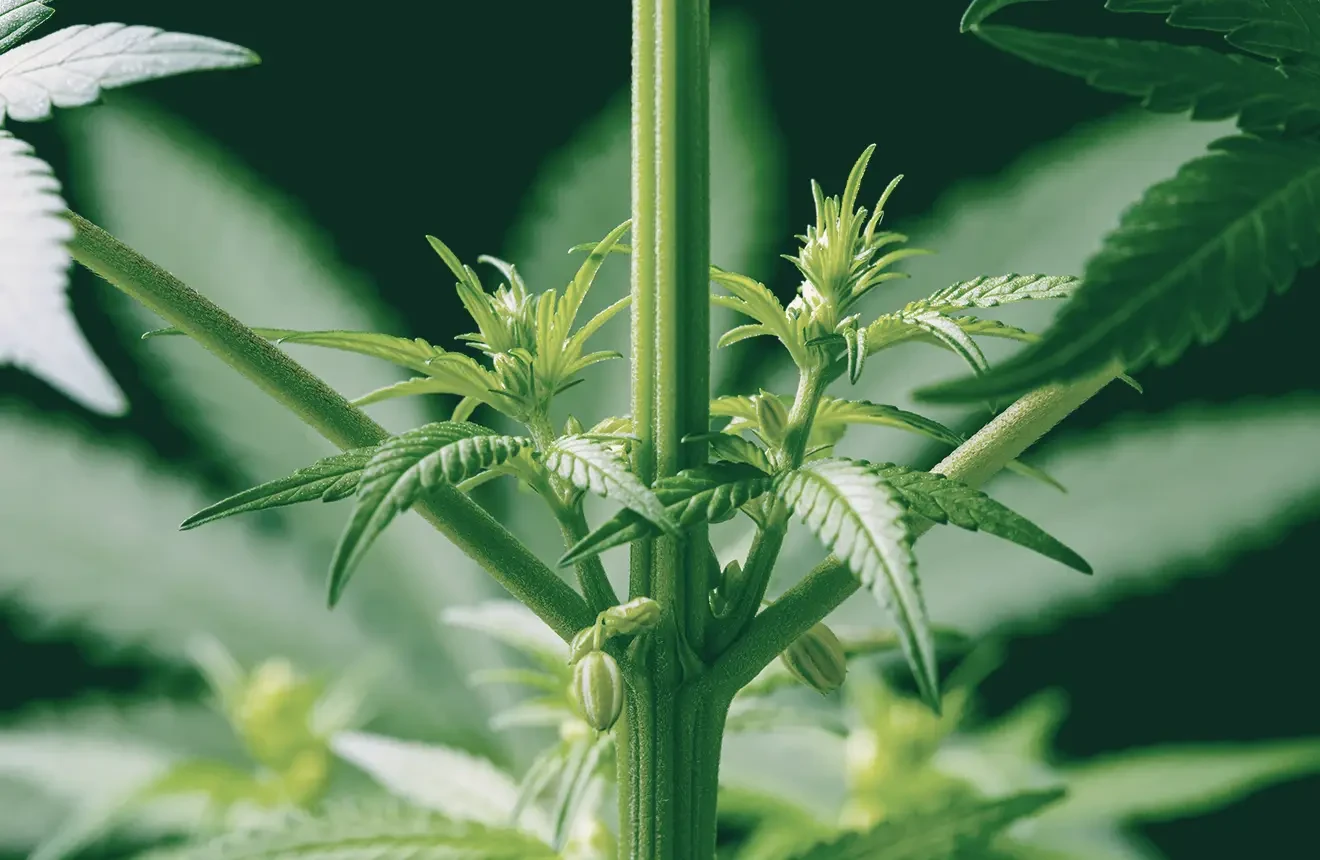
- Check the Nodes Up Close: Look where branches meet the main stem (the "nodes"). Females show a tear-shaped calyx with one or two fine, translucent hairs (pistils) poking out, often in a V-shape.
- Confirm the Hair, Not Just the Bump: A single green bump without hairs might still be an immature pre-flower. Wait 24–72 hours and re-check. Female pre-flowers have a distinct pointed shape, while males form rounder balls on a tiny stem.
- Don't Confuse Stipules for Pistils: At the base of each node are a pair of small, green, leaf-like spikes called stipules. These are on all plants and are not sex organs. Female pistils are the whitish hairs that emerge from within the calyx.
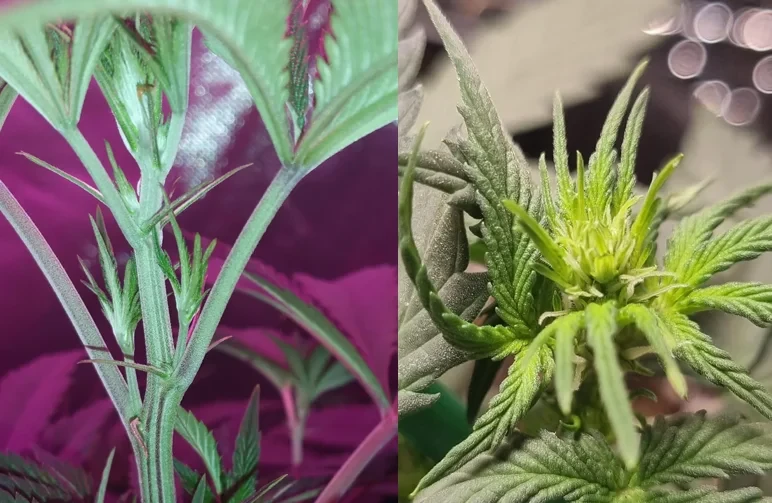
Anatomy of a Female: On the left, a clear view of the "Stipule Trap"—those green, leaf-like spikes that are often mistaken for pistils. Look closely behind them to see the actual female pre-flowers. On the right, the end goal: a mature female bud stacking resinous calyxes and vibrant pistils.
Image credits: u/Purple69Haze (left) and u/CarlSeeTwo (right) via Reddit.
How to Identify Male Weed Plants: What to Look For
Males are all about sacs and spacing. They are unmistakable once you know the signs.
- Pollen Sacs at the Nodes: This is the dead giveaway. Look for clusters of small, round balls on thin stems (pedicels). They hang slightly and group up like a tiny bunch of grapes. They have no hairs.
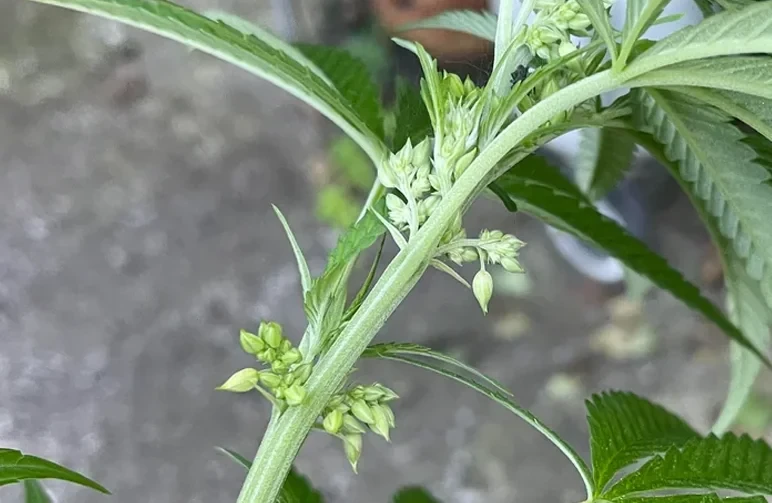
The "Bunch of Grapes" Stage: This is a textbook example of a mature male plant. Notice how the round pollen sacs aren't just single bumps; they are grouped in clusters and hang from tiny stems called pedicels. If your plant looks like this, it is dangerously close to releasing pollen. Isolate and remove it immediately.
Image credit: u/SoMuchLard via Reddit. - Taller, Leggier Frames: Males often surge upward early with fewer lateral branches. They build height, not density.
- Bell-Shaped Flowers (Later): As they mature, the sacs swell and can look like tiny green-white bells just before they open to release pollen.
Expert Tip: When in doubt, wait 24 hours. A female pre-flower won't change much, but a male plant will often show more pronounced pollen sac development in a single day. Patience prevents mistakes.
What Should You Do When You Identify a Male Plant?
Speed matters. One open sac can pollinate half a room if air movement is lively.
- Isolate Immediately: Turn off all fans near the plant to prevent airborne pollen.
- Mist the Plant: Lightly mist the entire male plant with water. This helps trap any loose pollen and prevents it from going airborne.
- Remove with Care: Place a plastic bag over the entire plant from the top down to the base. Secure the bag around the stalk, cut the plant at its base, and carry it out of your grow space.
- Clean the Scene: Wipe down all nearby surfaces and tools with a damp cloth. If you brushed against the plant, consider changing your shirt. Pollen is notoriously good at hitching rides.
What About Hermaphrodite Cannabis Plants?
Herms—plants that show both male and female sex organs—are the curveball. They can appear from genetics, stress, or a combination of both.
Two types to watch for:
- True Hermaphrodites: Develop separate male flowers (pollen sacs) and female flowers (pistils) at different nodes.
- "Nanners" (Bananas): These are pollen-producing anthers that pop directly out of female buds late in flowering. They are yellow, look like tiny bananas, and can be very sneaky.
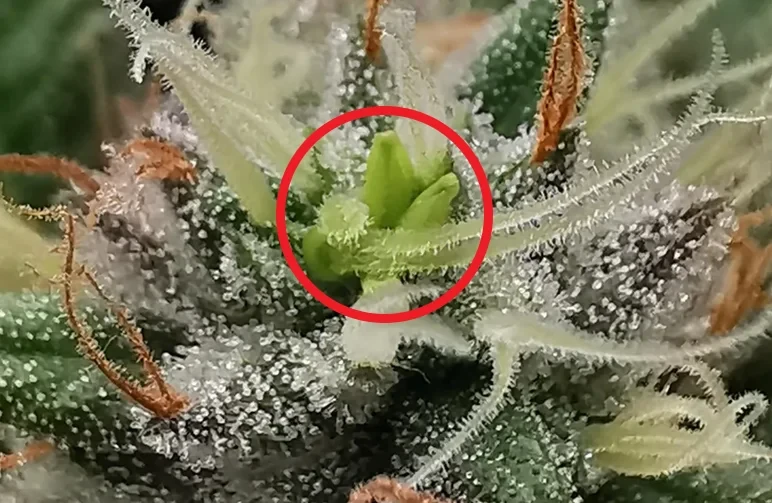
The Infamous "Nanner": Circled in red is a classic example of a hermaphrodite trait called an anther, or "nanner." Unlike rounded male sacs at the nodes, these yellow, banana-shaped structures pop directly out of the female bud. They can release pollen immediately upon appearing, potentially seeding your entire top cola.
Image credit: u/suzukirm128 via Reddit.
Common stressors that can trigger hermaphroditism include:
- Light Leaks: Even small light intrusions during the dark cycle.
- Temperature Spikes: Consistently exceeding 30 °C.
- Root Stress: Leaving a plant in a pot that is too small ("root-bound").
- pH Swings: Unstable pH in your soil or hydroponic system.
- Aggressive Late-Flower Stress: High-stress training or major pruning after week 3 of flower.
If you catch a few early "nanners," you can carefully tweeze them off with sterile tweezers and monitor the plant. If they keep appearing, the safest bet is to remove the plant to protect the rest of your crop.
The Role of Male Plants: Are They Ever Useful?
Absolutely. For breeders, a standout male is half the genetic equation, contributing vigor, disease resistance, structure, and even aroma potential. But for 99% of growers chasing top-shelf, seedless flower? Males don't belong anywhere near your budding females.
How to Guarantee Female Plants: feminised vs. Regular Seeds
If your aim is pure flower production, use feminised seeds. They are bred to produce only female plants (with a 99%+ success rate), simplifying your grow and maximizing your canopy space for bud sites.
feminised Seeds: The best choice for beginners and pros who want efficiency and a guaranteed harvest of smokable flowers. We hand-select and test every batch of feminised cannabis seeds for reliability.
Regular Seeds: Produce a mix of males and females (~50/50). Ideal only if you plan to pheno-hunt or run your own breeding projects. Be ready to sex and cull.
Autoflower feminised Seeds: Offer the same female guarantee but on a fixed, accelerated timeline. Our autoflower seeds are perfect for fast harvests.
Frequently Asked Questions (FAQ)
Can you tell a plant's sex from the seed?
No. The sex is determined by genetics, but it's impossible to tell just by looking at a seed.
How soon can a male release pollen?
Once pollen sac clusters are mature, they can open very quickly—sometimes within a few days of clearly forming. That's why we isolate at the first suspicion.
Do male plants smell like female plants?
They can have a cannabis aroma from terpenes in their leaves and stems, but it's far less pungent and complex than a flowering female. They lack the trichome-dense buds where most of the smell comes from.
Can pollinated buds still be consumed?
Yes, but they'll have seeds and reduced potency/aroma. Most people find them harsher to smoke. They are better suited for making edibles or hash to salvage some value.
Do clones change sex?
No. A clone is a genetic copy and will always be the same sex as its mother plant. Severe stress can cause a female clone to show hermaphrodite traits, but it will not turn into a true male.
What's the safest way to guarantee I only grow females?
Start with quality feminised seeds from a trusted source, then maintain a stable, stress-free environment. See our curated lineup of feminised cannabis seeds.
If you're still on the fence about a plant, snap clear node photos and hit us up. Our grow team's been doing this since the '90s, and we're happy to weigh in.