

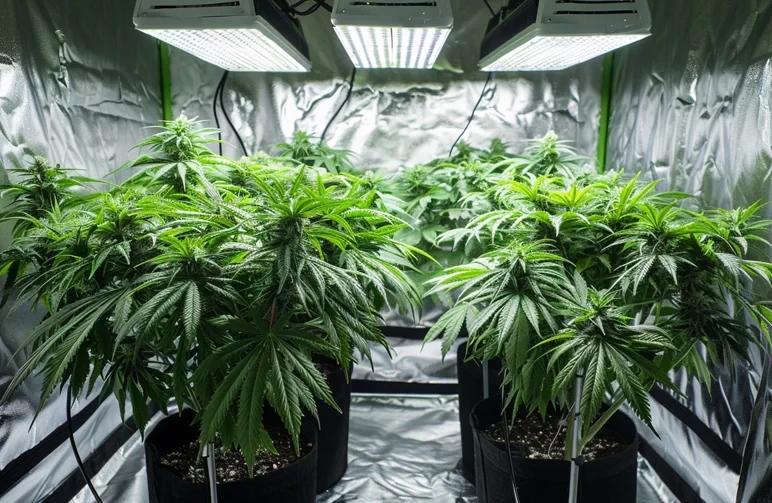
If you're staring at an empty grow tent wondering how many autoflowers you can fit without creating a jungle, you're in the right place.

The sweet spot isn't about cramming in as many plants as possible; it's a balance of your tent's size, your light's power, pot size, and training style.

In plain English: a few happy, well-spaced autos will always outperform a crowded canopy of plants fighting for light.

This guide provides a practical, beginner-friendly way to choose your plant count, avoid common mistakes, and maximize your yield. Let's make "How many autoflowers in a tent?" an easy decision.

Key Takeaways

  • Size your plant count by space and style: plan roughly 4–16 autoflowers per mΒ² (about 1–4 per ftΒ²), with common setups like 1–2 in a 2Γ—2, 4–6 in a 2Γ—4 or 3Γ—3, 4–6 (up to 9 small) in a 4Γ—4, and 12–18 in a 4Γ—8.
  • Let light dictate how many autoflowers in a tent: use ~100–150 W for 2Γ—2, 240–320 W for 2Γ—4 or 3Γ—3, 400–500 W for 4Γ—4, and ~800–1000 W total for 4Γ—8 so every plant gets even PPFD.
  • Use pot size as your yield throttle: run 3–5 gal pots for full-size autos and switch to ~2 gal only for SOG if you want many smaller plants.
  • Train early and gently (LST and light defoliation), keep 2–3 inches of air between leaf edges, and add an oscillating fan per 2–4 plants to prevent humidity and larf.
  • Match genetics to space: compact autos let you fit more per ftΒ², while medium/tall or stretchy lines need fewer plants and wider spacing.
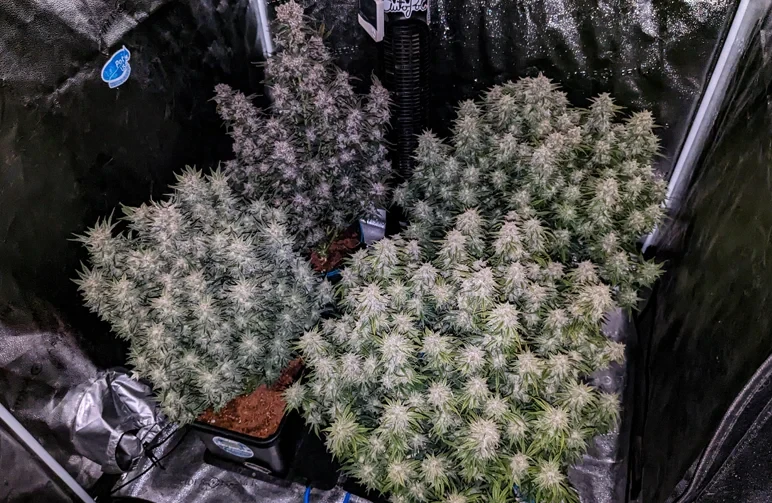
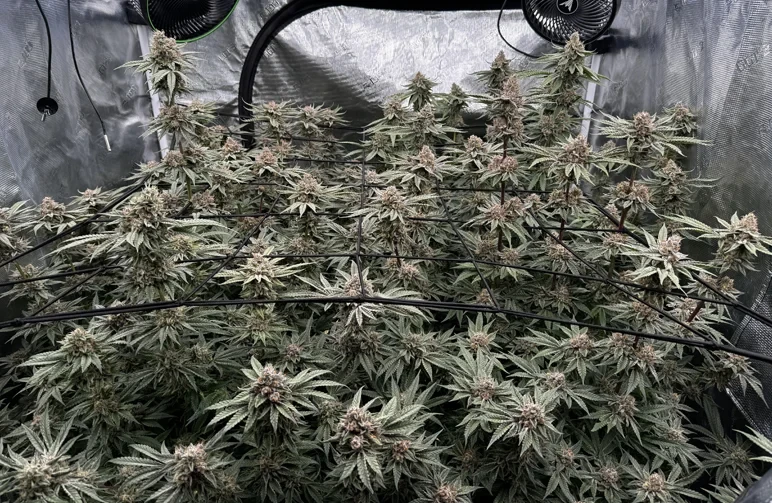
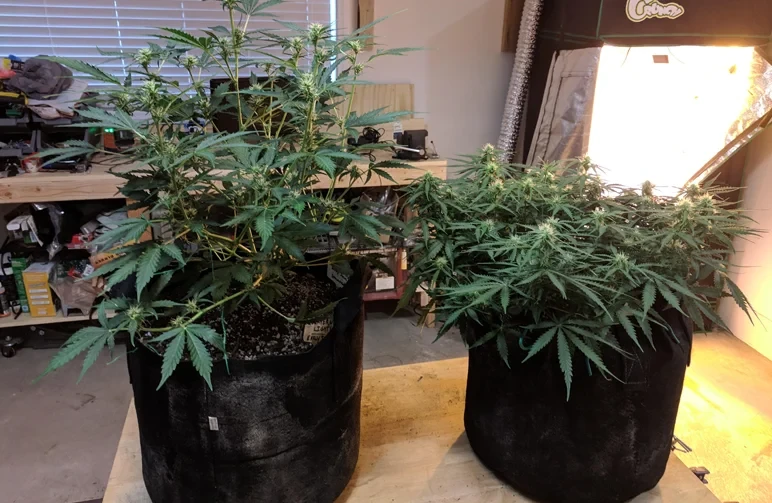
A side-by-side comparison of two cannabis grow tents: the left side shows an overcrowded canopy with tall, thin plants fighting for light; the right side shows properly spaced plants with thick, dense flower development and clear airflow.
Quality over quantity: On the left, an overcrowded tent creates a "jungle" where plants fight for light and airflow (Image: Darkstarlive/icmag.com). On the right, proper spacing and plant count allow each autoflower to develop thick, uniform colas from top to bottom (Image: u/stutsmonkey/Reddit).

Why Plant Count Is Crucial for Autoflowers

Autoflowers are perfect for tent growing. They stay compact, typically 65 cm–105 cm (2.1–3.4 ft), and race from seed to harvest on a constant 18-20 hours of light.

This stable schedule even lets you run plants of different ages in the same tent without issue.

But your plant count is critical. Too many plants leads to a war for light, poor airflow, and high humidityβ€”a recipe for mould and larfy buds. Too few, and you're wasting expensive light and potential yield.

The perfect number depends on four factors you control: genetics, pot size, training style, and your tent's environment.

As a baseline, you can fit roughly 4–16 autoflowers per square meter (about 1–4 per square foot), depending on how large and how trained each plant is.

Quick Reference: Autoflower Count by Tent Size

A cannabis spacing chart infographic showing plant count ranges for grow tents: 1-2 plants for a 2x2ft tent, 4-6 plants for a 2x4ft tent, and 4-9 plants for a 4x4ft tent.
The Autoflower Blueprint: This chart aligns with our recommended plant counts for the most common tent sizes. The lower number in each range represents a harvest of larger, well-trained plants, while the higher number represents a more crowded (SOG-style) setup.

Using common, yield-focused layouts with ~3–5 gal (10–15 L) pots:

  • 2Γ—2 ft (0.6Γ—0.6 m): 1–2 plants
  • 2Γ—4 ft (0.6Γ—1.2 m): 4–6 plants
  • 3Γ—3 ft (0.9Γ—0.9 m): 3–6 plants (often 4–6)
  • 4Γ—4 ft (1.2Γ—1.2 m): 4–9 plants (commonly 4–6: up to 9 small autos)
  • 4Γ—8 ft (1.2Γ—2.4 m): 12–18 plants with good spacing
  • Rule of thumb: 4–16 autos per mΒ² (about 1–4 per ftΒ²) depending on style.

Quick lighting pointers so your count matches your coverage (actual draw from the wall):

  • 2Γ—2: 100–150 W quality LED (full spectrum).
  • 2Γ—4: 240–320 W LED.
  • 3Γ—3: 240–300 W LED (or two bars at ~150 W each).
  • 4Γ—4: 400–500 W LED.
  • 4Γ—8: Two fixtures totaling ~800–1000 W LED.

We size lights first because light is yield. If your light doesn't reach the corners, those extra plants aren't helping, you're just growing shade.

The 4 Factors That Dictate Your Plant Count

Factor 1: Genetics Dictate Plant Size & Spacing

Not all autos are equal. Compact, indica-leaning strains usually grow short and bushy. Taller, sativa-leaning autos will stretch and demand more elbow room.

If a breeder describes a strain as "short/compact," you can fit more plants per square foot. If it's "medium/tall," reduce your count to give them space.

A good rule of thumb is to plan for each plant to occupy a 12–15 in (30 cm–38 cm) circle in small pots, and a 16–20 in (40 cm–50 cm) circle in 3–5 gal pots.

  • Why it matters: Overcrowded canopies block light from reaching lower bud sites and trap humid air, which is a major invitation for powdery mildew and bud rot.

Factor 2: Pot Size is Your Growth Throttle

Pot size directly controls the final size of your plant. For autos, we strongly recommend planting in the final pot to avoid the stress of transplanting.

  • 10–15 L (3–5 gal) pots: The gold standard for growing large, high-yielding autoflowers. This size provides ample room for healthy root development. Fabric pots are an excellent choice as they promote root pruning and better aeration.
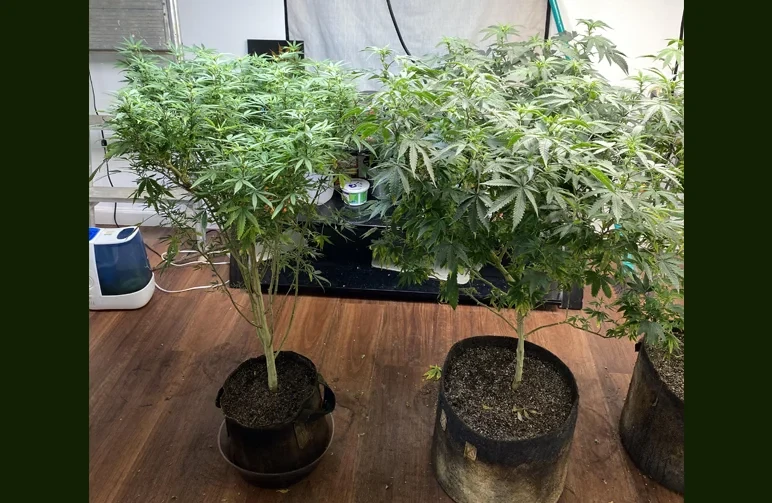
    A side-by-side comparison of two cannabis plants in fabric pots. The plant on the left is in a 3-gallon pot and is more compact; the plant on the right is in a 5-gallon pot and shows a much thicker stalk and a significantly broader leaf canopy.
    Pot size is your growth throttle: This side-by-side comparison shows the difference between a 3-gallon pot (left) and a 5-gallon pot (right). Notice how the larger root volume on the right leads to a much thicker main stem and a wider canopy footprint. (Image: u/Foxyyy_45/Reddit)
  • 7–9 L (2 gal) pots: Ideal for growing a larger number of smaller plants, especially when using the Sea of Green (SOG) method.

When arranging your pots, always ensure you can easily reach every single plant for watering and maintenance. Good access can make or break a grow cycle.

Factor 3: Training Style Maximizes Your Space

  • LST (Low-Stress Training): Gently bending and tying down stems to create a wider, flatter canopy. This technique is perfect for autos and allows you to use your light more efficiently.
    A low-angle shot of an autoflower cannabis plant in a fabric pot showing low-stress training (LST) techniques. Branches are tied down to the rim of the pot with string and binder clips to create a wide, horizontal plant structure.
    LST Mechanics in Action: Instead of letting the plant grow like a Christmas tree, user u/sillyskunk (Reddit) used binder clips and string to pull the branches horizontally. This "low-stress training" (LST) breaks apical dominance, allowing light to reach the inner nodes and creating a flat, high-yielding canopy.
  • Defoliation: The selective removal of leaves to improve airflow and light penetration. With autos, always be conservative. Only remove large fan leaves that are directly shading bud sites.
  • SOG (Sea of Green): Growing many small plants in small pots with minimal training to create a uniform "sea" of colas.

The more you train and organize the canopy, the more efficiently you can use space. But with autos, every decision needs to respect the clock. Gentle, early, and minimal wins.

Factor 4: Your Environment Must Support Your Plant Count

You must match plant count to your tent's environment:

  • Light Footprint: Your light is the engine of your grow. Check the manufacturer's PPFD map (light intensity chart). You need 600–900 Β΅mol/mΒ²/s across the entire canopy during flowering.
    If the corners of your tent are dim, adding a plant there will only produce shade and larf.
    A PPFD (Photosynthetic Photon Flux Density) heat map for a 4x4 grow tent showing light intensity values. The center of the tent shows high intensity in orange (over 1000 Β΅mol), while the four corners show significantly lower intensity in blue (under 500 Β΅mol).
    Why the corners are "danger zones": This PPFD map from migrolight.com shows the light intensity of a ~500W LED in a 4x4 tent. Note how the intensity drops by over 50% in the corners (blue). This is why we recommend keeping your plant count centered: plants in the blue zones will struggle to produce dense buds compared to those in the orange "sweet spot."
  • Airflow & Humidity: More plants mean more transpiration (water released into the air). Your inline fan should be rated to exchange the tent's full volume of air every 1-2 minutes.
    Add one oscillating clip-on fan for every 2–4 plants to keep leaves rustling gently.
  • VPD (Vapor Pressure Deficit): This measures the "thirst" of the air. Aim for 1.1–1.3 kPa in mid-flower. Staying in this range encourages the plant to transpire, which is how it "breathes" and pulls nutrients up from the roots.
    If VPD is off because humidity is too high, you risk stunting growth and inviting mould.

Detailed Breakdown by Tent Size: Your Grow Room Blueprint

2Γ—2 ft (0.6Γ—0.6 m):

Best: 1–2 autos in 3–5 gal pots. This is a boutique box, keep it clean and simple. One plant lets you train wide and hit the corners with light: two plants can work if you keep them tidy with early LST.

  • Light: 100–150 W LED.
  • Access tip: Put plants on a riser you can rotate. Crowding a 2Γ—2 turns watering into yoga you didn't sign up for.

2Γ—4 ft (0.6Γ—1.2 m):

Run 4–6 autos in a single or double row. This is an apartment all-star, good airflow and a logical path to water each plant.

  • Light: 240–320 W LED (bar style preferred for even spread).
  • Layout: Six 3-gal pots fit snugly: for 5-gals, four plants breathe easier.
  • Training: Early LST plus a light defol around week 4–5 (remove only leaves blocking major bud sites).

3Γ—3 ft (0.9Γ—0.9 m):

Expect 4–6 autos for balanced yield and airflow. Up to 9 very small plants is possible, but it's cramped and not beginner-friendly.

  • Light: 240–300 W LED.
  • Airflow: Two clip fans, one under-canopy, one above.
  • Pro move: Use plant saucers and a wet-vac for clean run-off management: crowded 3Γ—3s get messy fast.

4Γ—4 ft (1.2Γ—1.2 m):

The versatile standard. 4–6 autos in 3–5 gal pots deliver chunky plants with room to work: up to 9 smaller autos can work with tight training.

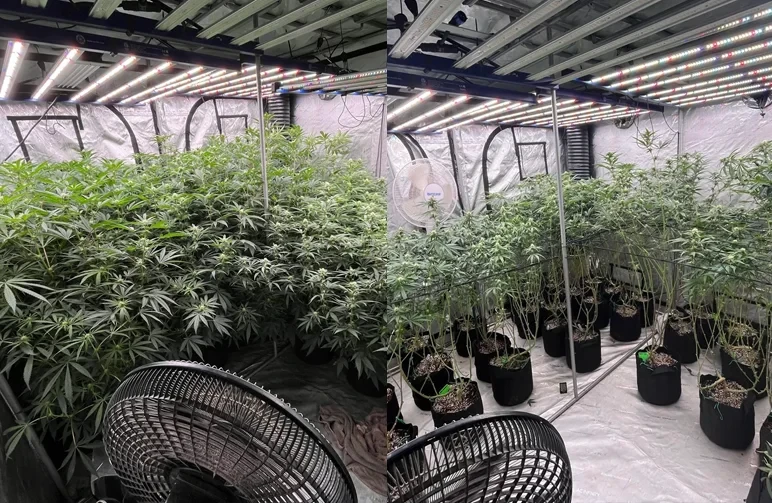
A crowded but well-managed grow tent filled with flowering cannabis plants. Multiple white oscillating fans are clipped to the tent poles at different heights to provide airflow through a dense green canopy where leaves are touching.
Managing the "Lasagna" Canopy: When plants are spaced this closely, airflow is your only defense against mould. User u/MissAsshole (Reddit) demonstrates a tent at maximum capacity, using three separate oscillating fans to ensure air moves through the dense layers of foliage where leaves overlap.
  • Light: 400–500 W LED.
  • Layout: A 2Γ—2 grid for four big girls, or a 3Γ—3 grid for nine smaller ones.
  • Training: LST from the 4th–5th node: consider gentle lollipopping (removing weak lower growth) around week 4–5 to focus energy upward.

4Γ—8 ft (1.2Γ—2.4 m):

Think two 2Γ—4s side-by-side. 12–18 autos in 3–5 gal pots is the sweet spot. You can pack more, but quality and manageability usually slide.

  • Light: Two fixtures totaling ~800–1000 W LED for even coverage.
  • Airflow: One oscillating fan per 3–4 plants, plus a strong inline fan with carbon filter.
  • Workflow: Divide into zones by age, autos let you run staggered harvests under the same 18–20 hour schedule.

Spacing rule you can eyeball: after training, aim for 2–3 inches (5 cm–[7.5:cm]) of air between leaf edges at full prayer. If leaves are layered like lasagna, you're overcrowded.

Why Tents Are Perfect for Growing Autoflowers

  • Total Environmental Control: Tents allow you to perfectly dial in temperature, humidity, and light, protecting your plants from outside fluctuations.
  • Compact & Efficient: Autos stay a manageable height (65 cm–105 cm), fitting perfectly within standard tents with enough headroom for lights and carbon filters.
  • Fast Harvest Cycles: With many autos finishing in just 9–12 weeks, a tent setup allows for multiple, perpetual harvests per year.
  • Simple Light Schedule: A single "set-it-and-forget-it" 18-20 hour light schedule works from seed to harvest.
  • Odor & Discretion: A sealed tent combined with a carbon filter completely neutralizes odors, keeping your hobby private.

Frequently Asked Questions (FAQ)

Q: Is it better to run more small autos or fewer big ones?

Fewer, well-lit autos almost always win for beginners. Four properly trained plants in a 4Γ—4 will outshine nine cramped ones.

Why? Each plant gets the photons, airflow, and root volume it needs, so you avoid larf (fluffy popcorn buds) and humidity headaches.

Q: What pot size should I use for autos in a tent?

We recommend 10–15 L (3–5 gal) pots from seed to harvest for full-size autos. That size supports strong roots without inviting a giant, unmanageable canopy.

Smaller pots (2 gal) work for SOG runs if you want many smaller plants and quick turnarounds.

Q: Can I put 3 autoflowers in a 2Γ—2?

You can, but we don't advise it for a first or second grow. One or two plants in 3–5 gal pots are easier to water, train, and light properly. If you try three, use smaller pots and expect tight defoliation timing and trickier airflow.

Q: How many autos in a 4Γ—4 for beginners?

Start with 4–5 plants in 3–5 gal pots. You'll have room to train, stakes to place, and space to move around for watering and inspections.

Q: What environmental targets should I keep while packing more plants?

  • Temperature: 75–80Β°F (24 Β°C–27 Β°C) lights on: ~70–75Β°F (21 Β°C–24 Β°C) lights off.
  • Relative Humidity (RH): 60–65% weeks 1–3, 50–55% weeks 4–6, 45–50% late flower.
  • pH: 6.0–6.5 in soil: 5.8–6.2 in coco.
  • Airflow: Leaves should gently dance. If they're still, add a fan: if they're thrashing, dial it back.

Q: Panic check, did I ruin my plant by bending it?

Probably not. With autos, gentle LST early (days 14–28) is fine. If you creased a stem, tape it and support with a tie. Watch the plant, not the calendar, healthy new growth means you're okay.

Q: Do I need a dehumidifier if I add more plants?

Maybe. More foliage means more transpiration (plants "sweat" water vapor). If RH won't stay in range, either lower plant count, boost exhaust, add another oscillating fan, or add a small dehumidifier just outside the tent pulling room RH down.

A technical diagram of a grow tent ventilation setup titled "Air must Flow!". It shows numbered components including an exhaust fan at the top left, an intake fan at the bottom right, an internal clip fan for circulation, and two cannabis plants centered under a grow light.
The Mechanics of Fresh Air: This diagram from bigplantscience.co.th shows the ideal setup for humidity control. By pulling fresh air in from the bottom (6) and exhausting warm, humid air from the top (1), you create a constant cycle that prevents stagnant "pockets" of moisture from settling on your buds.

Conclusion: Plan Your Count, Maximize Your Harvest

Choosing how many autoflowers to grow in your tent is a simple equation: balance your space with the power of your light and the size of your pots.

For most growers, the sweet spot isΒ 1–2 autos in a 2Γ—2, 4–6 in a 2Γ—4 or 3Γ—3, 4–6 in a 4Γ—4, and 12–18 well-spaced plants in a 4Γ—8.

Always prioritize quality over quantity. Four happy plants with ample light and airflow will always yield more than nine crowded, stressed-out ones.

Start with a conservative plant count, use 3-5 gallon pots, and apply gentle LST early on.

Ready to start your most successful grow yet? Now that you've mastered your plant count and spacing, you're ready to tackle the rest of the grow cycle.

Read our step-by-step guide on how to grow autoflowers to ensure your tent stays healthy from seed to harvest. Once you have the knowledge, the next foundation is great genetics.

Explore our testedΒ autoflower seeds at WeedSeedsExpressβ€”we provide reliable genetics with detailed strain information and a germination guarantee to ensure your plans start strong from day one.